Founders
Creating the Impossible
September 7, 2026
Every time we start a new and challenging piece, we likely won't be able to fully understand its nuances, or play it with any semblance of professional competence. I may want to play Vivaldi's Winter, but I won't just wake up tomorrow being able to perform it perfectly. Merely wanting to play a piece is not enough to become proficient. Such achievement, though impossible today, is remarkably achievable on a longer timescale. As such, many of us have learned that diligent, repeated practice brings us closer to excellence; however, this is often easier said than done.
We are all at one time or another faced with this reality: we want to accomplish some task or goal, but we can never find the motivation to follow through. For someone who's just starting out, the mountain of activation energy required to execute a radical idea seems insurmountable. They haven't yet learned that excellence never comes on the first pass, and quickly become overwhelmed. The truth behind this fact is that everyone, to include the best people in a field, started at ground zero too. So, how does one actually begin without being drowned by perfectionism or scope? There is an excellent idea that the most growth potential occurs when doing work 4% beyond one's current proficiency level. As small victories are progressively made, what began as embarrassingly mundane accomplishments become closer, step by step, to the most extravagant achievements imaginable.
The Embrace Strings Chinrest began with a simple problem. For Turner, no chinrest was comfortable for his giraffe neck. For me, finding a comfortable posture felt equally impossible despite being closer to the average height, at 5' 11". As a high school musician with facial acne, I couldn't comfortably assume the correct posture, and using my instrument was a delicate balance between pain and poor neck position. It became difficult for me to Embrace my musical potential when I had to be careful how I held my instrument, and my posture suffered as a result. Naming the problem is a good starting point, and its solution is obvious: the chinrest should adjust to the user.

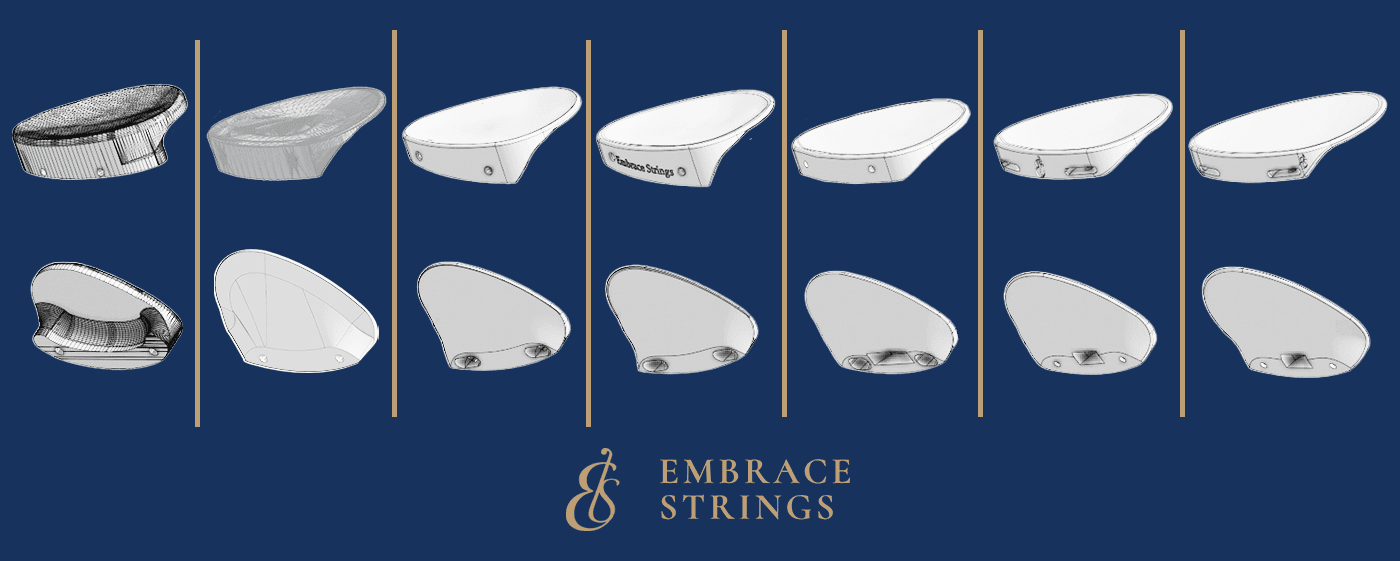
Turner's first attempt to solve this identified need was to hand carve a chinrest out of wood, and put two screws in the bottom of it. The chinrest could, after fully removing it from the instrument, be adjusted from the underside with a screwdriver. He then 3D scanned this design, to be 3D printed for production. Although not a technically robust solution or marketable product, this concept was a necessary step in realizing our idea.
We had a clear vision of what we wanted to achieve, despite not having the tools we needed to get there on day one. My first idea for a chinrest adjustment mechanism involved cutting a tiny threaded nut in half, and then pressing this half-nut into a rod via a spring-loaded button. Suffice to say that with a dozen small parts and an overall failure to effectively satisfy the design criteria, it was a pretty imbecilic idea. So too was the one that following it, and the one after that. This process of failure and iteration is natural, though we often don't place enough emphasis upon it. In most measures of success, for instance our education system, society frames failure as a negative outcome that must be avoided at all costs. In reality however, the shortcomings and objective failures of our early prototypes were instrumental steps toward an end goal we didn't have the skills to reach yet.
Across dozens of prototypes we learned more, and moved closer to realizing a balance between adjustability and comfort. Making the Embrace Strings Chinrest, and improving upon it every day, is about creating the most comfortable and customizable chinrest for every musician. Along the way, we proved that our vision for the end product was a stronger indicator of success than our starting point. Stay tuned for exciting updates about our product development, and in the meantime, check out our chinrest trial to find your fit.
Play freely,
Declan McPhillips